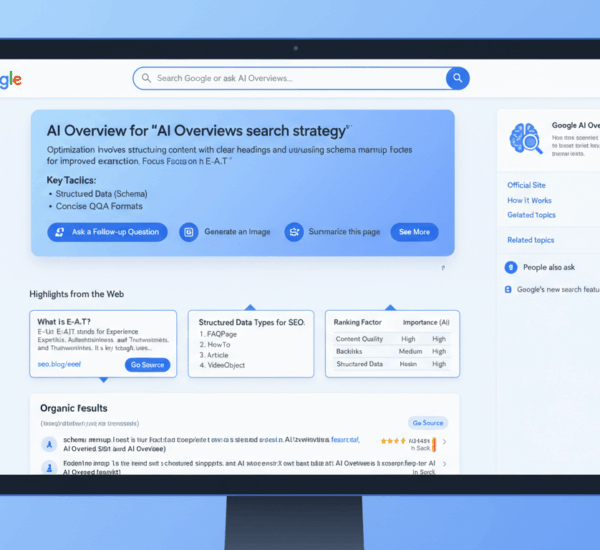
Last updated: 2025 For a deeper dive, see our complete guide to AI search ranking factors.
Your customers are changing how they search. Instead of scrolling through ten blue links, they’re asking ChatGPT, Google Gemini, and Perplexity direct questions — and getting direct answers. If your brand isn’t part of those answers, you’re invisible to a rapidly growing segment of your market.
At Be The Answer, we specialize in helping businesses appear in AI-generated responses. This guide breaks down exactly how AI search engines select their sources, and gives you a step-by-step playbook to get your brand mentioned, recommended, and cited by the large language models (LLMs) that power modern search.
How AI Search Engines Actually Work
Before you can optimize for AI search, you need to understand what’s happening behind the scenes when someone asks ChatGPT “What’s the best CRM for small businesses?” or tells Gemini “Find me a reliable plumber in Austin.”
Training Data vs. Real-Time Retrieval
AI models get their knowledge from two distinct sources:
- Training data: The massive corpus of text — websites, books, articles, forums, documentation — that the model learned from during its training phase. This is “baked in” knowledge with a cutoff date.
- Retrieval-augmented generation (RAG): Real-time web searches that feed fresh information into the model’s context before it generates a response. This is how ChatGPT with browsing, Gemini, Perplexity, and Google’s AI Overviews work.
This distinction matters because your optimization strategy needs to address both. You want your brand embedded in the training data and surfacing in real-time retrieval.
How LLMs Select and Rank Sources
Unlike traditional search, AI models don’t use a PageRank-style algorithm with transparent ranking factors. Instead, they rely on pattern recognition across their training data, weighting sources based on:
- Frequency and consistency: How often your brand is mentioned across multiple independent sources in the same context
- Source authority: Content from well-known, high-authority domains carries more weight
- Recency: For RAG-based systems, fresh content ranks higher
- Contextual relevance: How precisely your content matches the user’s query intent
- Structured clarity: Content that’s well-organized and clearly states facts is easier for models to extract and cite
The key insight: AI models form a “consensus view” from many sources. A single blog post won’t move the needle. You need a consistent presence across the web that reinforces the same narrative about your brand.
Step-by-Step Strategies to Get Mentioned by AI
Here’s the actionable playbook we use with our clients at Be The Answer to build AI visibility from the ground up.
1. Nail Your Entity Identity
AI models think in terms of entities — people, brands, products, and concepts. Before an LLM can recommend you, it needs to understand what you are with zero ambiguity.
Action steps:
- Create and maintain a comprehensive Wikipedia page (if you meet notability criteria) or, at minimum, a Wikidata entry
- Claim and fully complete your Google Business Profile, including categories, services, and attributes
- Ensure your LinkedIn company page, Crunchbase profile, and industry directory listings all present consistent information
- Use the exact same brand name, description, and categorization everywhere — inconsistency confuses models
2. Build Topical Authority Through Content
LLMs favor sources that demonstrate deep expertise on a topic. A single “Ultimate Guide” isn’t enough. You need a content ecosystem that covers your niche comprehensively.
Action steps:
- Create pillar content — in-depth, 2,000+ word guides on your core topics
- Support each pillar with cluster content — specific articles that answer individual questions and link back to the pillar
- Write content that directly answers questions in clear, declarative statements. Instead of “There are many factors to consider…” write “The three most important factors are X, Y, and Z.”
- Include original data, case studies, and specific numbers. LLMs are more likely to cite content that contains unique, verifiable information.
- Update your content at least quarterly to maintain recency signals
3. Optimize Content Structure for LLM Consumption
The way you format and structure your content directly impacts whether an AI can extract useful information from it.
Action steps:
- Use clear H2 and H3 headings that mirror common questions (e.g., “What is the best…” “How much does… cost”)
- Lead paragraphs with the answer first, then the explanation. AI models pull from the first sentence or two under a heading.
- Use definition-style formatting where appropriate: “AI search optimization is the practice of…”
- Include bulleted and numbered lists for multi-step processes or multi-item recommendations
- Add an FAQ section using question-and-answer format on every important page
- Write concise, self-contained paragraphs. Each paragraph should make a complete point without requiring the surrounding context to understand it.
4. Implement Structured Data (Schema Markup)
Schema markup helps both traditional search engines and AI systems understand your content’s meaning with precision.
Priority schema types for AI visibility: For more on this topic, read our best AI SEO agencies.
- Organization schema: Name, description, founding date, founders, URL, logo, social profiles, and
sameAslinks to all your official profiles - FAQPage schema: Mark up your FAQ sections so AI systems can directly extract question-answer pairs
- Product/Service schema: Price, availability, reviews, features
- Article schema: Author, publication date, publisher, headline — establishes content provenance
- LocalBusiness schema: For businesses with physical locations — address, hours, service area
- Person schema: For thought leaders and founders — establishes author authority
The sameAs property is particularly important. It tells AI systems that your website, LinkedIn page, Twitter profile, and Wikipedia entry all refer to the same entity, strengthening your entity recognition.
5. Earn Third-Party Mentions and Citations
This is where most brands fall short. Your own website is only one piece of the puzzle. AI models build their “opinion” of your brand from what others say about you across the web.
Action steps:
- Get featured in roundup articles and listicles in your industry (“Top 10 project management tools,” “Best marketing agencies in [city]”). These are exactly the format LLMs pull from when making recommendations.
- Publish guest articles on high-authority sites in your niche, with your brand naturally mentioned
- Earn press coverage — even small industry publications matter. Use HARO (now Connectively), Qwoted, or direct journalist outreach.
- Contribute to Reddit, Quora, and niche forums where your brand is naturally relevant. AI training data heavily includes forum discussions, and RAG systems actively pull from Reddit.
- Get reviewed on trusted platforms — G2, Capterra, Trustpilot, or industry-specific review sites. High ratings and review volume are strong signals.
- Build a presence on GitHub, Stack Overflow, or industry-specific platforms if you’re in tech — these are heavily represented in training data.
6. Strengthen Author and Brand Authority Signals
Google’s E-E-A-T framework (Experience, Expertise, Authoritativeness, Trustworthiness) isn’t just for traditional SEO — these same signals influence how AI models weight your content.
Action steps:
- Attribute content to real, named authors with detailed bio pages linking to their credentials and social profiles
- Ensure your authors are published elsewhere — guest posts, interviews, podcast appearances — so the AI can cross-reference their authority
- Display trust signals prominently: certifications, awards, client logos, years in business
- Maintain an active, professional social media presence that reinforces your expertise
- Build backlinks from authoritative domains — .edu, .gov, industry associations, major publications
Monitoring Your AI Visibility
You can’t improve what you don’t measure. Here’s how to track whether your AI optimization efforts are working.
Manual Testing
The simplest approach: regularly query AI platforms with the questions your customers would ask.
- Test across multiple platforms: ChatGPT (GPT-4), Gemini, Perplexity, Claude, and Bing Copilot
- Ask recommendation-style questions: “What’s the best [your category] for [your target customer]?”
- Ask comparison questions: “How does [your brand] compare to [competitor]?”
- Test with variations of the same question — AI responses can differ based on phrasing
- Document results in a spreadsheet, tracking mentions, sentiment, and citation sources
- Re-test monthly to track progress
Automated Monitoring Tools
Several platforms now offer AI visibility tracking:
- Otterly.ai — tracks your brand mentions across ChatGPT, Gemini, and Perplexity over time
- Peec AI — monitors AI search visibility with competitive benchmarking
- Profound — enterprise-level AI search analytics
- Manual API queries — for technical teams, you can programmatically query AI APIs and parse results for brand mentions
Key Metrics to Track
- Mention rate: What percentage of relevant queries include your brand in the response?
- Sentiment: When mentioned, is your brand described positively, neutrally, or negatively?
- Position: Are you the first recommendation, or buried in a list of five?
- Citation source: When AI cites a source for mentioning you, which page is it pulling from?
- Competitor comparison: How do your mention rates compare to competitors for the same queries?
Common Mistakes That Kill Your AI Visibility
We’ve audited hundreds of websites for AI search readiness. These are the most common problems we see: For more on this topic, read our generative engine optimization guide.
1. Content That’s Vague or Hedging
AI models prefer definitive, clear statements. If your content is full of “it depends,” “there are many options,” and “results may vary,” you’re telling the AI you don’t have a concrete answer. Be specific. Share your actual recommendations with reasoning.
2. No Third-Party Validation
Having a great website isn’t enough. If no one else on the internet mentions your brand in the context of your industry, the AI has no corroboration. You need independent sources reinforcing your relevance. This is the single biggest gap we see in most businesses’ AI search strategies.
3. Blocking AI Crawlers
Some websites have inadvertently blocked AI crawlers like GPTBot, Google-Extended, or ClaudeBot via their robots.txt file. Check yours immediately. If you’re blocking these user agents, AI platforms can’t index your content for retrieval.
Check these user agents in your robots.txt:
GPTBot(OpenAI/ChatGPT)Google-Extended(Gemini training)ClaudeBot(Anthropic/Claude)PerplexityBot(Perplexity)CCBot(Common Crawl, used by many models)
4. Thin or Duplicate Content
Pages with 300 words of generic copy don’t give AI models anything valuable to extract. Similarly, if you’ve duplicated the same service description across ten location pages with only the city name changed, AI systems will recognize the low value. Invest in unique, substantial content for every important page.
5. Ignoring the Conversational Layer
People query AI in natural language: “What’s the best Italian restaurant near downtown that’s good for dates?” If your content only targets keywords like “Italian restaurant downtown,” you’re missing the conversational nuance. Write content that addresses the full, natural question — including the intent behind it.
6. Treating AI SEO as a One-Time Project
AI models update their training data and retrieval systems regularly. Your competitors are optimizing too. The brands that maintain and grow their AI visibility treat it as an ongoing process, not a one-time checklist.
The Future of AI Search Optimization
AI search is still evolving rapidly. Here’s what we’re watching at Be The Answer:
- Multi-modal search: AI systems increasingly process images, video, and audio. Optimizing non-text content with proper metadata, transcripts, and descriptions will become critical.
- Personalized AI responses: As AI assistants learn user preferences, the same query may produce different brand recommendations for different users. Building broad authority becomes even more important.
- AI-specific advertising: Platforms may introduce paid placement within AI responses. Early organic authority will provide a competitive moat.
- Source attribution standards: As AI-generated content faces scrutiny, expect more robust citation and attribution — making it even more important to be a citable source.
Frequently Asked Questions
How long does it take to appear in AI search results?
For RAG-based systems (Perplexity, ChatGPT with browsing, Gemini), improvements can appear within weeks as new content gets indexed and retrieved. For baked-in training data, it depends on when the model is next updated — typically every few months. Most clients see measurable improvements within 60–90 days of consistent optimization.
📚 Continue Reading
Can I pay to appear in ChatGPT or Gemini responses?
As of 2025, there is no direct paid placement within ChatGPT or Gemini’s conversational responses. Visibility is earned through content quality, authority signals, and third-party validation. However, some AI-powered search features (like Google AI Overviews) may incorporate sponsored results in the future.
Does traditional SEO still matter for AI search?
Absolutely. Many AI systems use traditional search results as their retrieval source. If your page ranks well in Google, it’s more likely to be pulled into Gemini’s AI Overviews and other RAG-based systems. Traditional SEO and AI search optimization are complementary, not competing strategies.
How is AI search optimization different from regular SEO?
Traditional SEO optimizes for ranking in a list of links. AI search optimization focuses on getting your brand mentioned and recommended within a generated answer. This requires stronger emphasis on entity identity, third-party consensus, clear and extractable content, and presence across multiple platforms — not just your own website.
What if AI mentions my brand negatively?
AI models reflect what they find across the web. If negative content about your brand is prominent, it can surface in AI responses. The solution is proactive reputation management: generate more positive content, earn positive reviews, get featured in favorable press coverage, and address the root cause of any negative sentiment. Over time, the positive signals will outweigh the negative.
Should I block AI crawlers to protect my content?
This is a business decision, but from an AI visibility standpoint, blocking crawlers removes you from the conversation entirely. If your goal is to be recommended by AI, you need to allow access. The brands that embrace AI crawling gain visibility; those that block it become invisible in AI-generated results.
Get Expert Help With AI Search Optimization
AI search is the biggest shift in how consumers discover brands since Google launched. The businesses that adapt now will dominate their categories in AI-generated recommendations for years to come.
At Be The Answer, we help businesses build systematic AI visibility — from entity optimization and content strategy to third-party authority building and ongoing monitoring. If you’re ready to make your brand the answer AI gives your customers, get in touch with our team.